
ISCRIVITI - Ti informeremo sulla nostra azione di cura e testimonianza
Report Urban Peripheries Report
March 26, 2026, Rome – In the Urban Peripheries, the right to health often remains unfulfilled. This is what emerges from the report “OUTSKIRTS – Health and marginalization in the neighborhoods of Rome: Bastogi and Idroscalo di Ostia”, presented today by Medici per i Diritti Umani (MEDU) in collaboration with Fondazione Charlemagne, as part of the Periferiacapitale program.
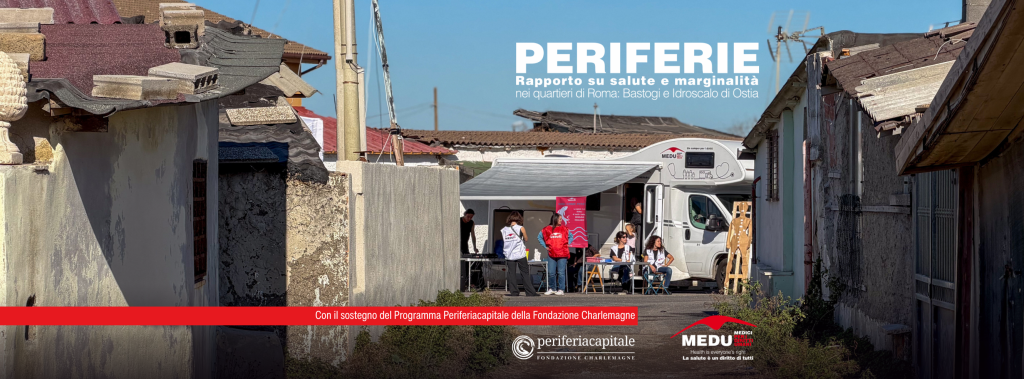
The report documents conditions of access to healthcare in Rome’s peripheral areas through the field experience of MEDU’s mobile clinic “Un Camper per i diritti”, active since 2025 in Bastogi and Idroscalo di Ostia. These neighborhoods represent significant examples of how social marginalization, housing insecurity, and isolation can exacerbate existing weaknesses in the healthcare system, producing concrete effects on people’s health and well-being. The report offers an in-depth, inside analysis of the socio-health challenges in these two areas.
The data highlight a strong gap between formal access and actual access to care: although around 70% of those assisted report having a general practitioner assigned, only 48% say they use this service regularly. Similarly, while 77% of users possess a health card, only 17% have one that is currently valid. The lack of official residency registration is one of the main obstacles. This administrative fragility, closely linked to housing conditions, produces discontinuity in treatment pathways and fuels insecurity and mistrust. The most frequently observed conditions during medical visits involve the cardiovascular system, followed by skin, respiratory, and metabolic disorders. These are mainly chronic conditions, often already known to patients, but managed inconsistently or inadequately, confirming difficulties in accessing and maintaining continuous care.
Barriers to healthcare access are multiple and interconnected: physical and logistical difficulties, economic obstacles, bureaucratic complexity, and mistrust of institutions. These are compounded by widespread low health literacy, which makes it difficult for people to navigate services and access care appropriately.
In these contexts, another particularly critical phenomenon is observed: a significant portion of the population gives up on seeking care even before attempting to access services, fueling a form of “upstream” exclusion that makes the healthcare gap even deeper and more invisible.
What emerges in the outskirts is not an exception, but a signal concerning the system as a whole: barriers to healthcare access are not only an issue in marginalized neighborhoods, but appear there in a more visible and acute form, revealing a broader process of erosion in access to the National Health Service affecting all citizens. When access to care depends on living conditions, the right to health risks losing its universal nature.
The report also highlights the strategic role of local healthcare in reducing inequalities. In light of the findings, MEDU addresses some recommendations to institutions: strengthening the National Health Service, simplifying access to residency registration, and enhancing local healthcare services to bridge the gap between formal rights and actual access to care.
Health cannot depend on the neighborhood one lives in, housing stability, or economic conditions. Making the right to care effective means defending and strengthening a healthcare system capable of reaching people before they are forced to give up on care.
The report is available in Italian at the following link.
Project: Un camper per i diritti/rm