
ISCRIVITI - Ti informeremo sulla nostra azione di cura e testimonianza
LIBYA: TOPOGRAPHY OF A TORTURE CENTRE
Rome, 19 July 2021 – While the Italian Parliament approved the renewal of funds intended to the Libyan Coast Guard on Friday the 16th of July, 2021, the details of the atrocities committed against migrants in detention centers in the North African country, whether controlled by the government in Tripoli or by criminal groups, are becoming increasingly clear.
The following report is based on the depositions of five migrants collected over the past 9 months by the medical-psychological team of Medici per i Diritti Umani (MEDU) at its ambulatory in Ragusa, Sicily. The five witnesses are vulnerable migrants who have been assisted by MEDU and who have survived several months of abduction and torture at the Al Harsha detention center in Libya. All of them were released only after their families paid the ransom.
The witnesses not only described the atrocities that are committed in this illegal center, but also denounced the connivance between the criminals in Al Harsha and the militias who control Al-Nasr Prison in Al-Zawija, also called Ossama Prison by the witnesses, under the formal control of the Libyan government. Witnesses also clearly detailed the topography of the Al Harsha center.
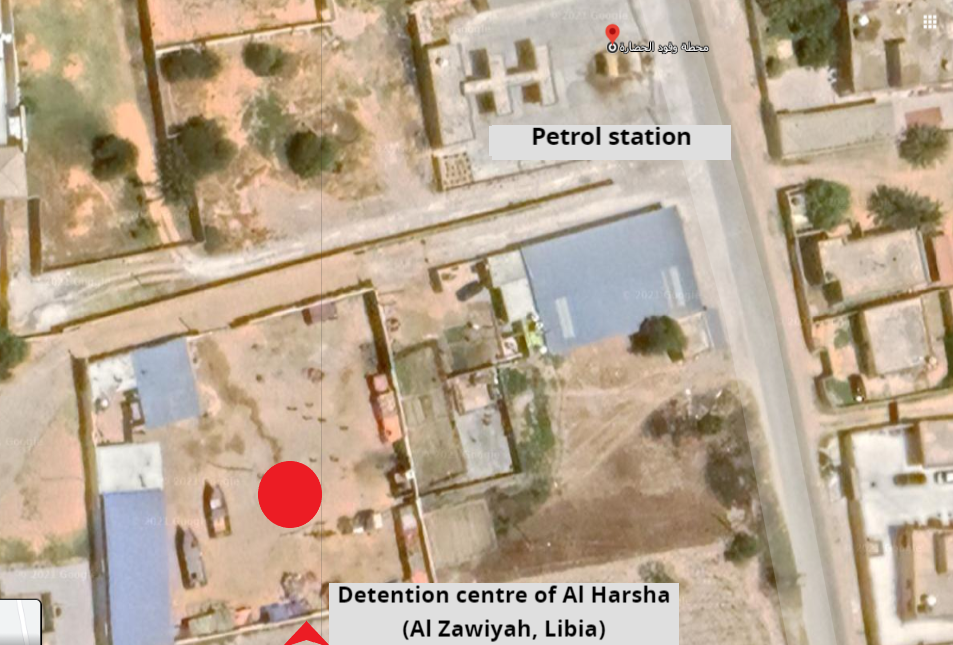
The Al Harsha camp is located in Al-Zawija, a coastal town 50 kilometers west of Tripoli. Al-Zawija is one of the main departure points used by traffickers to smuggle migrants to Italy. The center is located near a mosque and is surrounded by high walls. As can be seen from the aerial map (photo above), there are several warehouses and containers and a large courtyard that often serves as a storage area for boats (the sea is not far away).


According to the testimonies of the migrants detained here, this center can contain up to 200-300 people. The head of the Al Harsha detention centre is a Libyan man named Haithem who also owns a petrol station a few meters from the center. Haithem has a group of armed and violent men and a right-hand man, his brother Ismael.
This is the testimony of a migrant collected on the 23rd of June 2021 by MEDU’s medical-psychological team: “Haithem is the name of the Libyan in charge of the Al Harsha informal prison. He gets help from his brother Ismael: they are violent, they have weapons and with their group they kept me locked up together with 300 other migrants, from Bangladesh and sub-Saharans countries. They beat and mistreated me for two months, treated me worse than an animal, and denied me food and water. While I was imprisoned in Al Harsha, I saw dozens of Bengali migrants like me being punched and kicked, beaten with sticks, humiliated. Haithem, the Libyan, often gets other migrants to help him torture detained people: he forces them to do it and he even pays some of them. While I was in there, I saw soldiers and other Bengali migrants coming several times. I realized and heard that they were from Ossama Prison. Haithem keeps relations with the soldiers from that prison and does business with them. They too demand ransom and sell the prisoners. Soldiers from Ossama Prison used to break into the facility where we were held and have parties using drugs, food and alcohol with Haithem’s group. They were often drunk or under the influence of drugs and used violence against us and hit us. It was terrible.”
According to testimonies, the migrants (from Bangladesh and sub-Saharan countries) detained in Al Harsha are systematically tortured by the kidnappers with the purpose of extortion. In order to be released, a ransom of 3.000/5.000 euro must be paid. The most atrocious forms of physical and psychological torture are carried out inside. Al Harsha’s Libyan criminals often demand the help of other migrants in the practice of torture. Some of these migrants, of Bengali origin, are currently on trial in Palermo court under charges of collaboration in violence and abuse. Some of the migrants who told their story to MEDU are currently testifying at the hearings.
MEDU once again calls for a radical change in the Italian government’s relations with Libya on migration, wishing for an approach that considers respect for the human rights of migrants as a prior requirement to any kind of cooperation. Although it is Italy’s duty to cooperate with Libya in order to contribute to its stabilization and democratization process, our government cannot hypocritically ignore the extremely serious human rights violations committed against tens of thousands of migrants held in its formal and informal detention centers, nor can it ignore the role played by the Libyan Coast Guard in returning thousands of people to these real, modern torture camps. Blocking migratory flows at all costs seems to be the only real objective pursued by Italy and Europe today.